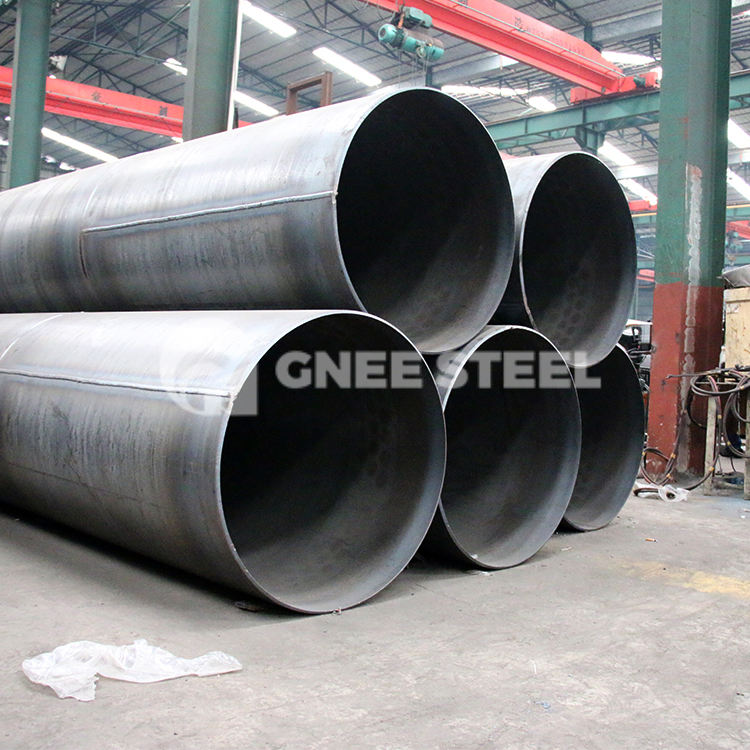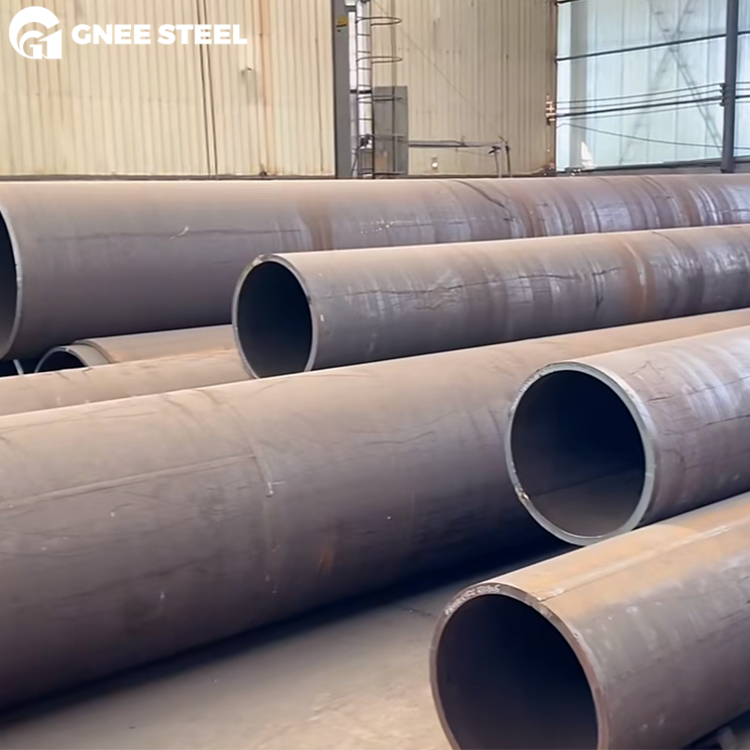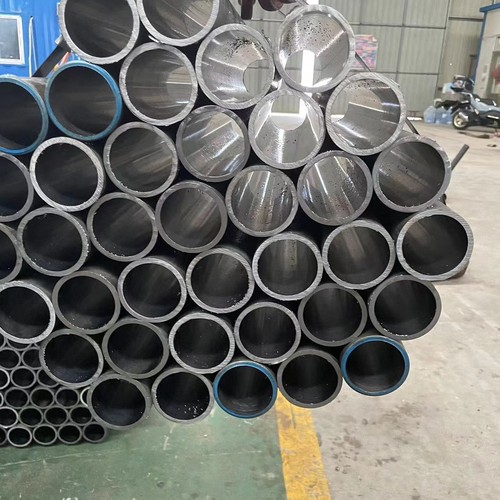
ASTM A519 1045 honed seamless steel tube is a medium-carbon precision tube (UNS G10450, also called SAE 1045, C45 or CK45) whose bore is finished by honing or skiving-and-roller-burnishing for dire...
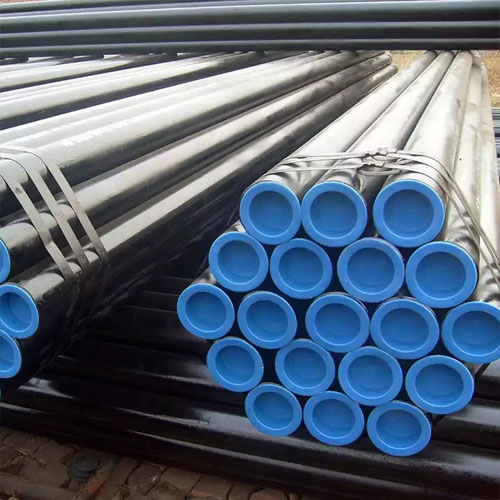
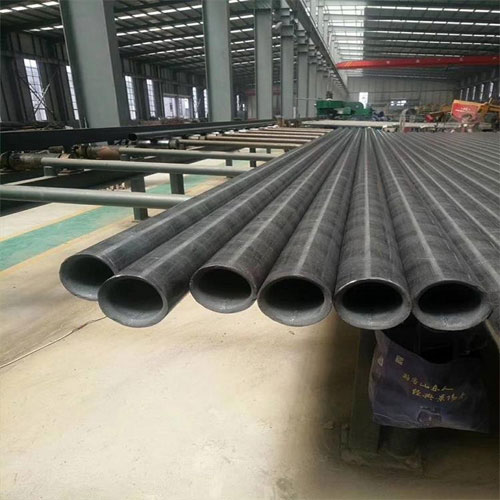
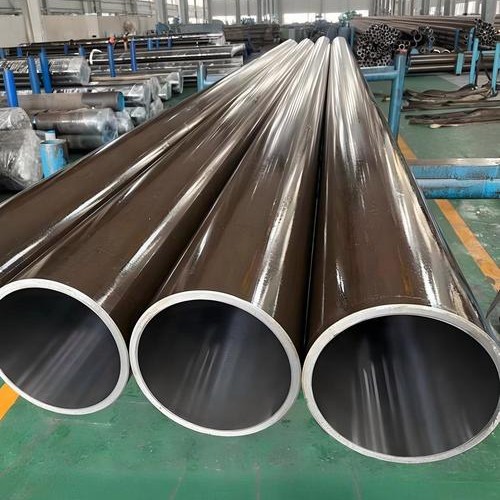
ASTM A519 1045 honed seamless steel tube is a medium-carbon precision tube (UNS G10450, also called SAE 1045, C45 or CK45) whose bore is finished by honing or skiving-and-roller-burnishing for direct assembly into hydraulic cylinder barrels. The 1045 honed tube is supplied to ID tolerance H8/H9 with a cross-hatched bore of Ra 0.2-0.4 um, in round sizes up to 325 mm (12 3/4 in) outside diameter. The property that decides whether a barrel is strong enough is the delivery condition, not the grade name: in the usual cold-drawn plus stress-relieved state 1045 delivers about 620 MPa tensile and 550 MPa yield.
1045 carbon steel is a plain carbon steel with no chromium or molybdenum, so it is the economical choice for cylinder barrels that do not need the high strength and through-hardening of an alloy grade such as 4140. This page covers the grade identity, the chemical and mechanical data, how the bore is finished, and the single decision that moves the design pressure by more than double — the delivery condition.
| Parameter | Capability |
|---|---|
| Standard | ASTM A519 / A519M-24a (UNS G10450) |
| Grade | 1045 (SAE 1045, C45, CK45, S45C, 45 steel) |
| Outside diameter | 25-325 mm (1-12 3/4 in); A519 round maximum 325 mm |
| Inside diameter | 20-300 mm, honed to H8/H9 (H7 servo) |
| Wall thickness | 2-50 mm |
| Length | Up to 12 m, cut-to-length available |
| Surface finish (bore) | Ra 0.2-0.4 um honed; SRB reaches 0.2 um |
| Straightness | 0.3 mm/m or better |
| End finish | Plain, beveled or threaded as specified |
| Delivery condition | BK, BKW, BK+S (+SR), GBK (+A), NBK (+N); QT on request |
| Certification | EN 10204 3.1 MTC; third-party TUV / SGS / BV inspection available |
The A519 1045 chemical composition below is the heat-analysis data a mill certificate reports and the basis for the grade identity:
| Element | 1045 (A519 controlled) | C45E / CK45 (EN 10083-2, reference) |
|---|---|---|
| Carbon (C) | 0.43-0.50 | 0.42-0.50 |
| Manganese (Mn) | 0.60-0.90 | 0.50-0.80 |
| Phosphorus (P), max | 0.040 | 0.025 |
| Sulfur (S), max | 0.050 | 0.025 |
| Silicon (Si) | 0.10-0.35 (optional) | 0.40 max (C45E) |
1045 contains no chromium or molybdenum — those elements are absent because the grade is a plain-carbon steel. The steel’s strength and moderate hardenability come from carbon and manganese alone, which is why 1045 is cheaper than chromium-molybdenum grades such as 4140.
| Condition | Tensile MPa (ksi) | Yield MPa (ksi) | Elongation % |
|---|---|---|---|
| Hot-rolled (HR) | 517 (75) | 310 (45) | 15 |
| Cold-drawn (BK) | 620 (90) | 550 (80) | 5 |
| Cold-drawn + stress-relieved (BK+S, +SR) | 552 (80) | 483 (70) | 8 |
| Annealed (GBK, A) | 448 (65) | 241 (35) | 20 |
| Normalized (NBK, N) | 517 (75) | 331 (48) | 15 |
Quenched and tempered is not in the A519 base table and must be ordered separately. Note that some suppliers quote a single “600 / 355 / 16” set of values for 1045; that mixes conditions and should be read against the table above rather than used as one number.
| Grade | Type | Tensile / Yield (typical, strong condition) MPa | When to choose |
|---|---|---|---|
| 1026 | Plain carbon, low carbon | 490 / 415 | Light-duty, low-cost barrels |
| 1045 | Plain carbon, medium carbon | 620 / 550 (BK+S) | Economical medium-strength barrels |
| 4140 | Cr-Mo alloy | 855 / 690 (Q&T 28-32 HRC) | Heavy-wall, high-strength, fatigue-critical barrels |
The rule is simple: pick 1045 for cost-driven medium-strength barrels, move to 4140 only when the wall, pressure or fatigue demand exceeds what plain carbon can deliver.
The 1045 hydraulic cylinder tube is the workhorse barrel material for mobile and industrial hydraulics: a honed seamless steel tube for hydraulic cylinder service is specified wherever a ready-to-assemble barrel must carry moderate to high pressure, shock loading and long stroke cycles without secondary boring. Five application groups cover most orders:
The core use: excavators, loaders, cranes, dump trucks and industrial presses where the honed bore mates directly with a chrome-plated rod and seals.
Air cylinders need the same smooth, tight bore for leak-tight operation, usually at lower pressure than hydraulic service.
Lifting arms, harvesters and material-handling equipment use 1045 honed tube where cost per barrel matters more than maximum strength.
Suspension bushings, engine-mount sleeves and chassis sleeves exploit 1045’s machinability and wear resistance rather than its pressure rating.
Any component that benefits from a straight, dimensionally stable, ready-to-machine tube gains from the cold-drawn plus stress-relieved condition.
| Condition | Yield MPa | Use it for |
|---|---|---|
| Cold-drawn + stress-relieved (BK+S) | 483-550 | Standard hydraulic cylinder barrels (default) |
| Normalized (NBK, +N) | 331 | Barrels needing better ductility and weldability |
| Annealed (GBK, A) | 241 | Non-pressure machined parts, not pressure barrels |
| Quenched and tempered (on request) | up to about 700 | Only when a project calls for it explicitly |
For a hydraulic cylinder barrel the default is cold-drawn plus stress-relieved at about 620 MPa tensile and 550 MPa yield; normalized is the alternative when ductility and weldability lead. Do not design a pressure barrel around the annealed value.
No. ASTM A519 is a seamless mechanical tubing standard and carries no pressure rating. The 1045 honed tube is a precision component whose bore is finished for a hydraulic cylinder; the cylinder itself is pressure-designed and verified against a pressure-pipe or cylinder standard. Do not specify A519 where the code demands A106, A335 or a pressure-vessel rule.
1045 is a plain-carbon steel with no chromium or molybdenum, while 4140 is a chromium-molybdenum alloy. In the same cold-drawn plus stress-relieved condition 1045 reaches about 620 MPa tensile and 550 MPa yield; 4140 quenched and tempered to 28-32 HRC reaches about 855 MPa tensile and 690 MPa yield. Choose 1045 for economical medium-strength barrels and 4140 only when heavy-wall high-strength or superior fatigue resistance is required.
Yes for procurement purposes. ASTM A519 grade 1045, SAE 1045, and the European designations C45, CK45 and C45E (material number 1.0503) are the same medium-carbon steel. Japanese S45C and Chinese 45 steel are also the same grade. The steel is identical; only the standard and certificate format differ, so state both the A519 grade and the EN/JIS grade on the order.
After honing the bore is normally supplied to ISO 286-1 H8 or H9 (H7 for servo cylinders), with a cross-hatched surface roughness of Ra 0.2-0.4 um. Straightness is held at 0.3 mm/m or better. Note that these bore values are set by the honing or skiving-and-roller-burnishing process and by EN 10305-1, not by ASTM A519 itself.
Not by default. Because A519 is a mechanical tubing standard with no pressure rating, hydrostatic testing is an optional supplementary requirement (S1) and is not performed unless the purchaser specifies it. Nondestructive electric tests such as eddy current or ultrasonic examination are added only when the order calls for them.
Yes, with thermal discipline. For a typical heat with carbon 0.45 percent and manganese 0.75 percent the carbon equivalent is CE IIW about 0.575 and CE Pcm about 0.496. Preheat to 150-200 degrees C for heavier sections and apply post-weld stress relief; this is milder than 4140 because 1045 has no alloy hardenability boost.
For cylinder barrels the default is cold-drawn plus stress-relieved (BK+S, also written +SR) at about 620 MPa tensile and 550 MPa yield, or normalized (NBK, +N) at about 517 MPa tensile and 330 MPa yield. Avoid the annealed condition (about 450 MPa tensile, 240 MPa yield) for pressure barrels and do not assume a quenched-and-tempered value unless you order it explicitly.
Both finish the bore to a tight tolerance. Honing abrades the surface with stones and gives Ra 0.2-0.4 um; skiving and roller burnishing (SRB) work-hardens the surface and reaches Ra 0.2 um or better. The choice is driven by seal type, batch volume and cost, not by a simple better or worse, and neither term changes the fact that the parent tube is still A519 grade 1045.