A pipe can only run straight on its own. What makes a pipeline turn, branch, widen or narrow, join up, and seal off are the small components we call fittings. Elbows, tees, reducers, couplings, unions, and caps — everyone can say the names, but on real procurement and installation sites mistakes are common: the wrong long- or short-radius elbow, a reducer installed backwards, a coupling missing its rubber gasket, or threaded and welded fittings mixed on the same line — and the moment pressure testing starts, it leaks and the work has to be redone.
First memorize the six roles fittings play in a pipeline; every fitting afterward maps to one:
By angle: the most common on site are 90° and 45° elbows. A 90° elbow makes a right-angle turn; a 45° elbow makes only a half turn with less resistance, and two 45° elbows are often combined when a large change of direction is needed.
By radius of curvature: the ratio of the elbow’s centerline arc radius R to its nominal diameter D is the most critical specification. A long-radius (LR) elbow has R = 1.5D — gentler curvature, lower flow resistance, and less erosion/wear; it is the default choice with the highest usage, and is preferred for steam, pump discharges, and solid-laden media. A short-radius (SR) elbow has R = 1D — sharper curvature, smaller footprint, used only where space is tight and the service is low-pressure and non-critical.
By process: carbon-steel pipe elbows are divided into pressed (seamless push-bent) elbows and induction-bent (shop/site-bent) elbows. Pressed/push-bent elbows are standard forged-rolled fittings with uniform specs and the widest use; induction-bent elbows are made by heating and bending pipe in the shop or on site, used for large diameters, special angles, or non-standard cases, requiring control of ovality and wall thinning.
⚠️ Default to R = 1.5D long radius
① Unless there is a special reason, choose R = 1.5D long radius; short radius only when space is insufficient. ② The elbow must match the pipe in material and pressure class — a pressed welded elbow pairs with seamless steel pipe and must not be forced onto a threaded malleable-iron line. ③ At pump discharges and erosive locations, prioritize long radius and consider a heavy (thickened) wall.
📖 GB/T 12459—2025 — Steel Butt-welding Pipe Fittings — Types and Parameters: specifies the types and dimensional parameters of steel butt-welding elbows (including 45°, 90° long/short radius), tees, reducers, and caps.
Straight tee: the branch meets the run at 90°, the most common branch fitting; when all three ends are the same diameter it is an equal tee, when the branch is one or two sizes smaller it is a reducing tee.
Lateral / Y tee: the branch inserts at roughly 45°, giving smoother flow, lower local resistance, and less tendency to clog or silt up — used more often where a drainage stack connects to a horizontal run, or at pump-suction branch points.
Cross: a four-way that branches two ways at once, for symmetric double branching; but the node carries complex stresses and is less used in high-pressure industrial lines.
⚠️ If you fear clogging or resistance, choose a lateral tee
When the branch carries a large flow or the medium contains impurities, prefer a lateral tee; a reducing tee only reduces the branch by a limited amount (typically 1–2 sizes) — for a larger reduction, switch to a “straight run + welded branch outlet (olet)” or a reducer + equal-tee combination.
Concentric reducer: symmetrically tapered, both ends centered on the same axis; used for vertical-line diameter changes. If used on a horizontal pump suction, an air pocket forms at the top of the pipe.
Eccentric reducer: one side is a straight edge, with two installations — flat on top (FOT, straight edge up) and flat on bottom (FOB, straight edge down). Horizontal pump suction lines uniformly use flat-on-top installation: the top edge is a straight line so gas travels along the pipe top and doesn’t accumulate — the pump won’t cavitate, won’t lose prime, won’t be noisy.
When to use flat on bottom: for horizontal lines carrying solids, slurry, or needing to drain settled deposits, use flat on bottom so impurities flow along the pipe bottom; a clean-water pump suction wrongly using flat on bottom will trap an air pocket at the pipe top.
⚠️ Horizontal pump suction: eccentric reducer, flat on top
① Horizontal pump suction: eccentric reducer flat on top — this is the most frequently tested and most often wrongly installed rule on site. ② Vertical-line diameter change uses a concentric reducer. ③ Small-diameter threaded reducing commonly uses a bushing (internal/external threaded reducer), but a bushing reduces the flow area sharply and should not replace an eccentric reducer at a pump suction.
📖 GB 50235—2010 — Code for Construction of Industrial Metallic Piping: specifies the installation direction of piping components (including reducers) and piping connections to equipment such as pumps; horizontal pump-suction reducing commonly uses an eccentric reducer flat on top.
Coupling (direct/sleeve): a short internally threaded sleeve joining two same-diameter externally threaded pipes; the most basic connector in malleable (galvanized) iron fittings; also available as a reducing coupling doubling as a small diameter change.
Union: consists of two threaded joints and a lock nut, allowing quick disassembly without rotating either pipe; installed upstream/downstream of water meters, valves, and equipment that need frequent maintenance — far more convenient to take apart than a coupling.
Bushing (internal/external thread): a reducer fitting with large external thread and small internal thread, for small-diameter size reduction; note its flow cross-section shrinks severely, so it shouldn’t be used at pump suctions.
Cap and plug: a cap fits over and seals a pipe end; a plug (threaded plug) screws into a tee or internal thread to seal a branch; during pressure testing, plugs are heavily used for temporary sealing and must each be removed afterward to avoid leaving any behind.
⚠️ At positions needing frequent disassembly, leave a union
① Malleable threaded fittings (malleable cast iron piping connectors) are made to GB/T 3287, most common in galvanized water-supply and heating systems; when tightening, wrap PTFE tape or use lead-oil-and-hemp, and never overtighten by brute force and crack the casting. ② For unions, keep the sealing face flat and the gasket in place. ③ Register pressure-test plugs to prevent leaving any in the line.
📖 GB/T 3287—2024 — Malleable Cast Iron Piping Connectors: specifies the types, dimensions, and technical requirements of threaded malleable cast iron fittings such as elbows, tees, couplings, unions, bushings, caps, and plugs.
📖 GB/T 14383—2021 — Forged Socket-welding and Threaded Fittings: specifies requirements for small-diameter forged socket-welded and threaded elbows, tees, reducers, and caps, used in high-pressure industrial piping.
What it is: first roll-groove a circular groove at each of the two pipe ends, slip on a C-shaped rubber gasket, then clamp the two grooves with two cast-iron housing halves and tighten the side bolts — joining the pipes into one, with no threading and no welding.
Rigid coupling: after clamping, the two pipes can hardly move relative to each other; most common on fire-sprinkler mains. Flexible coupling: the housing leaves clearance allowing a small angle and axial displacement; used at pump rooms, through settlement joints, and where vibration absorption and frost-heave resistance are needed.
Why fire protection loves it: fast installation, no open flame, can be rotated for alignment, easy to disassemble, and the zinc coating isn’t damaged — it is the mainstream connection for fire-sprinkler and galvanized water-supply steel pipe; paired with grooved elbows, tees, flange adapters, and other fittings in a complete system.
⚠️ The grooved coupling three-piece set: grooving, gasket, housing and bolts
① Groove depth and width must be qualified — too shallow won’t hold, too deep damages the pipe. ② The C-shaped rubber gasket must never be omitted, misaligned, or pinched/cut; rubber material must also suit the temperature/medium. ③ Leave a gap between the two pipes and align; both housing halves must seat into the grooves simultaneously, and bolts tightened diagonally and evenly. ④ For buried or corrosive environments, apply corrosion protection and judge applicability per the product requirements.
📖 GB 50261—2017 — Code for Installation and Acceptance of Sprinkler Systems: specifies pipe-end grooving, rubber gaskets, fastening, and acceptance of grooved connection system piping.
📖 GB 5135.11 — Automatic Sprinkler System — Part 11: Grooved Pipe Fittings: specifies product performance requirements for fire-protection grooved couplings and grooved fittings.
Flexible rubber joint (flexible connector / vibration-isolation collar): installed on pump suction and discharge lines to absorb pump vibration and noise and compensate for small installation misalignment and displacement; select by pressure class, don’t overtighten bolts and crush the rubber, and at pump discharges provide anti-pull-out restraints.
Metal hose / bellows expansion joint: metal hose for equipment piping vibration isolation and settlement protection; bellows expansion joint (expansion compensator) absorbs pipeline thermal expansion/contraction — set per calculation on long straight steam or hot-water lines, paying attention to pre-stretching/pre-compression and anchoring during installation.
After selecting the fittings, you still need to decide how pipes and fittings connect. The core is four things: pipe diameter, pressure level, what medium is carried, and whether frequent disassembly is needed.
One-line mnemonic: small-diameter low-pressure uses threaded; large-diameter frequent-disassembly uses flanges; high-pressure steam uses welding; fire fast-install uses grooved; plastic water supply uses solvent/heat-fusion; thin-wall stainless uses press.
⚠️ Don’t field-weld galvanized pipe
Galvanized steel pipe shouldn’t be field-welded — high heat burns off the zinc coating and the inner wall can’t be re-galvanized for corrosion protection. Fire and galvanized water-supply systems should use threaded, grooved, or flanged connections. The connection method on one pipeline should be unified at design stage, avoiding half threaded and half welded with mismatched fitting ends.
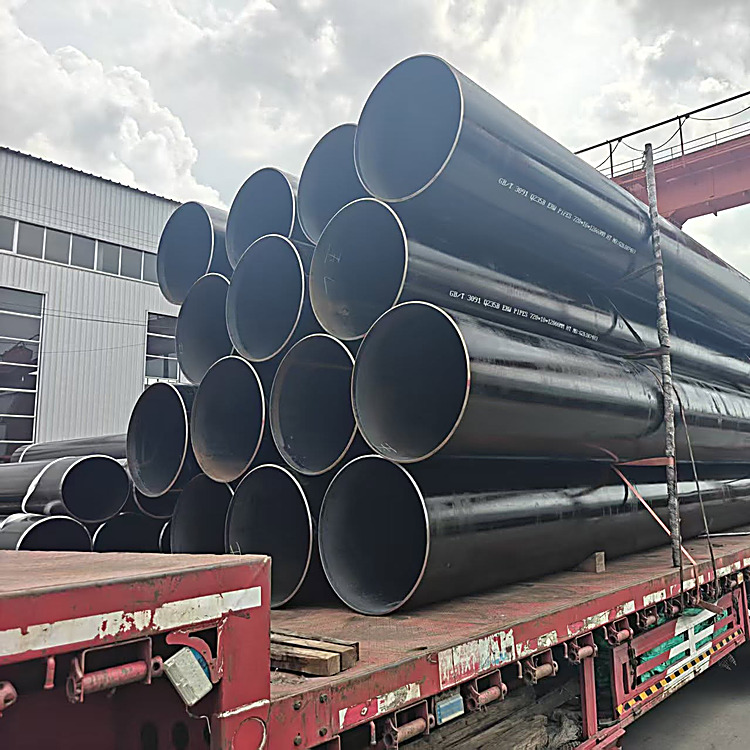
📖 GB/T 3091—2025 — Welded Steel Pipes for Low-pressure Fluid Service: specifies dimensions, shape, and technical requirements of welded steel pipes (including galvanized) for low-pressure fluid service, the base product standard for galvanized pipes used in threaded and grooved connections.
📖 GB/T 13401—2025 — Steel Butt-welding Pipe Fittings — Technical Specification: specifies technical requirements for plate-formed butt-welding fittings, paired with large-diameter welded pipelines’ elbows, tees, reducers, etc.
Fitting material must match the pipe and the medium; a material error is more insidious than a specification error:
✅ Five things to check when ordering
Before ordering, check five consistencies: nominal diameter (DN) consistent; pressure class (PN / schedule wall) not lower than pipe and valve; material matched to medium; connection type matched to pipe material (threaded/grooved/welded/solvent/heat-fusion/press); standard series consistent.
Save this diagram to your phone. The six pitfalls, again in words:
📖 GB 50242—2002 — Code for Acceptance of Construction Quality of Water Supply, Drainage and Heating Works: specifies installation quality and acceptance of indoor building water supply, drainage, and heating piping and fitting connections (one of the most used acceptance bases for indoor building installation).
Q: How to choose between a reducing tee and a reducer? For only a small branch reduction (generally 1–2 sizes smaller), use a reducing tee; for an overall diameter change of the run itself, use a reducer (concentric/eccentric). Horizontal pump-suction diameter change must use an eccentric reducer flat on top, and cannot be replaced by a bushing.
Q: Is a grooved coupling inferior to a flange and not pressure-resistant? No. Qualified grooved connections are widely used in fire and water-supply systems and can withstand the corresponding system pressure; the advantage is fast installation, dismantleability, and no damage to the zinc coating — but on the premise that the groove is qualified, the gasket correctly installed, the product complies with GB 5135.11, and construction/acceptance follows GB 50261.
Q: Eccentric reducer — flat on top or flat on bottom? For the vast majority of clean-water pump horizontal suction lines: flat on top (straight edge up), to prevent air pockets entering the pump; only horizontal lines carrying solids, slurry, and requiring drainage use flat on bottom. On vertical lines, use a concentric reducer directly.
Q: Why isn’t galvanized steel pipe allowed to be welded? Welding heat burns off the zinc coating at the joint, and the weld inner side can’t be re-galvanized for corrosion protection — it rusts quickly and can flake off and clog sprinkler heads. Fire and galvanized water-supply pipes should use threaded, grooved, or flanged connections (required by both GB 50242 and GB 50261).
Q: Can a leaking PP-R heat-fusion fitting be taken apart and re-fused? No. Heat-fusion socket is one-time formed and non-dismantleable; if it leaks you can only cut off the joint and re-fuse. Pay attention to fusion temperature and proper heating/insertion time; insert straight without rotation.