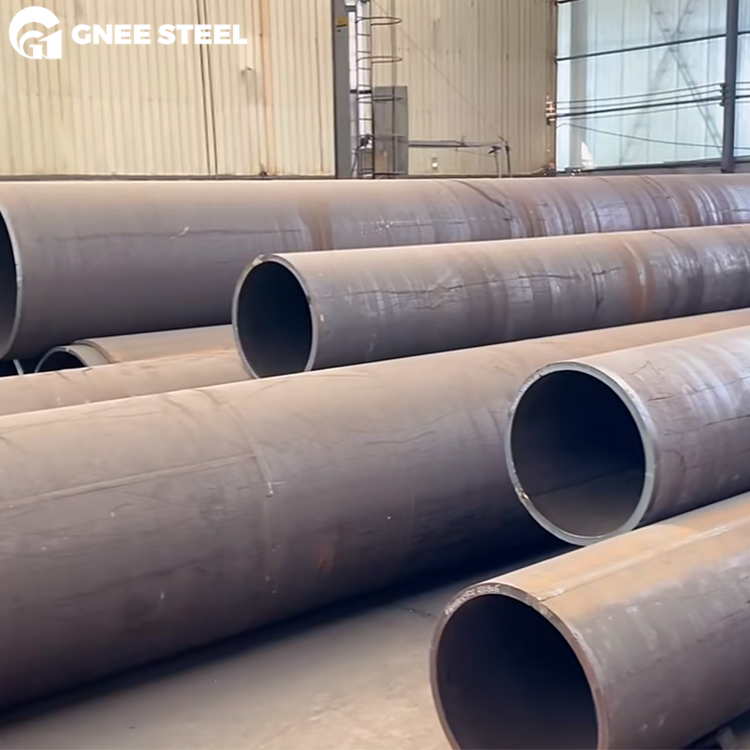
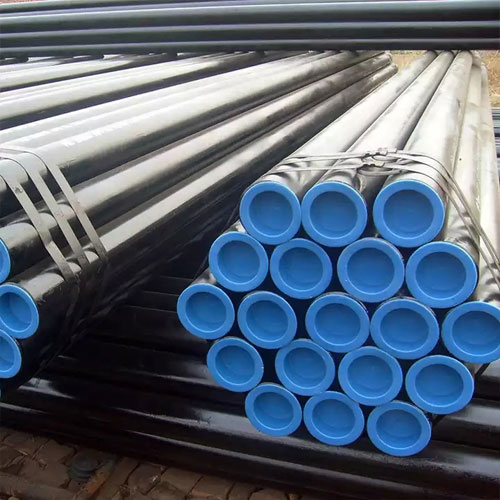
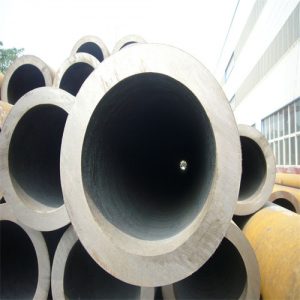
An 8-5/8 in. (219.08 mm) casing pipe is a threaded-and-coupled steel string made to API 5CT / ISO 11960, run in the intermediate or production section of a well and cemented in place. It is supplied in seven published weights from 24.00 to 49.00 lb/ft, with short round (STC), long round (LTC) and buttress (BTC) connections.
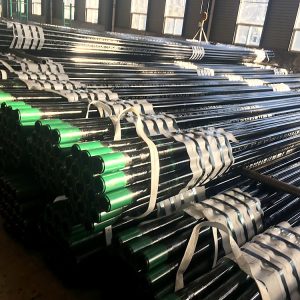
An 8-5/8 casing pipe is one nominal outside diameter inside the API 5CT casing family. An API 5CT casing pipe at this size is supplied either plain-end or, more usually, threaded at both ends and joined with a coupling. The designation 8-5/8 in. is 8.625 in. or 219.08 mm measured on the pipe body. Once it is run and cemented, the string becomes a permanent part of the well: it is not recovered during a workover, so the size, weight, grade and connection are fixed before the order rather than adjusted after delivery.
At this diameter the pipe is normally selected as an intermediate string to isolate a problem formation, or as a production string inside a larger size. That is the only well context needed here; everything below concerns the pipe itself. Note that a casing pipe for borehole in a water well is a different product under a different specification, even when the diameter is quoted in the same inches. For an oil or gas well the governing values come from the API 5CT casing tubing dimensions tables, summarized here for this one size.
The published casing pipe dimensions start with the outside diameter and a nominal weight. Reading the API 5CT casing table correctly matters here: the same 219.08 mm body carries seven different walls, and casing pipe sizes are named by the weight that follows the diameter. The same convention governs all API 5CT casing sizes from 4-1/2 to 20 in., and the API 5CT casing and tubing dimensions are set out in separate tables. For a water well or borehole the same words are used with a different product, so name the specification as well as the size.
Table 0 – API 5CT 8-5/8 in. casing dimensions (11th edition, Table C.18)
| Weight (lb/ft) | Weight (kg/m) | Wall (in) | Wall (mm) | ID (mm) | Drift (mm) | Plain end (kg/m) |
|---|---|---|---|---|---|---|
| 24.00 | 35.72 | 0.264 | 6.71 | 205.66 | 202.48 | 35.14 |
| 28.00 | 41.67 | 0.304 | 7.72 | 203.64 | 200.46 | 40.24 |
| 32.00 | 47.62 | 0.352 | 8.94 | 201.20 | 198.02 | 46.33 |
| 36.00 | 53.57 | 0.400 | 10.16 | 198.76 | 195.58 | 52.35 |
| 40.00 | 59.53 | 0.450 | 11.43 | 196.22 | 193.04 | 58.53 |
| 44.00 | 65.48 | 0.500 | 12.70 | 193.68 | 190.50 | 64.64 |
| 49.00 | 72.92 | 0.557 | 14.15 | 190.78 | 187.60 | 71.51 |
Nominal ID = outside diameter minus twice the wall. Drift is the API mandrel clearance, 3.18 mm (0.125 in.) below nominal ID for casing below 9-5/8 in. Weights include the threaded-and-coupled allowance; the last column is the plain tube only. Confirm the exact combination against the current API 5CT / ISO 11960 edition before it is written into a purchase order.
A casing weight is a label for a size-and-mass combination, not the measured mass of one foot of tube. The 8 5/8 casing weight ladder runs in seven steps, and each step buys wall thickness, collapse and burst capacity while taking bore away. Across the full range at this outside diameter the wall grows from 6.71 to 14.15 mm and the inside diameter falls by 14.88 mm. The change in bore, not the change in grade, is what decides whether a completion string will pass. The same sequence answers the 8 5/8 casing ID question: the bore is a consequence of weight, so the two are always quoted together.
| Designation (lb/ft) | Designation (kg/m) | Plain end (kg/m) | Connection allowance (kg/m) |
|---|---|---|---|
| 24.00 | 35.72 | 35.14 | 0.58 |
| 28.00 | 41.67 | 40.24 | 1.43 |
| 32.00 | 47.62 | 46.33 | 1.29 |
| 36.00 | 53.57 | 52.35 | 1.22 |
| 40.00 | 59.53 | 58.53 | 1.00 |
| 44.00 | 65.48 | 64.64 | 0.84 |
| 49.00 | 72.92 | 71.51 | 1.41 |
Allowance = designation minus plain-end mass. It varies with the connection: the same tube with STC, LTC or BTC does not weigh the same as a finished joint. Convert tonnage from the designation the order actually names.
Below are the mechanical requirements and the chemical limits for the grades most often met on 8-5/8 in. casing. Yield strength is only one input: it does not set collapse performance, connection capacity or resistance to sulfide stress cracking, and a higher number is not a remedy for a corrosive environment.
Table 1 – Mechanical requirements by grade (API 5CT)
| Grade | Yield min (MPa) | Yield max (MPa) | Tensile min (MPa) | Hardness max | Typical use at 8-5/8 in. |
|---|---|---|---|---|---|
| J55 | 379 | 552 | 517 | not set | Surface or shallow intermediate |
| K55 | 379 | 552 | 655 | not set | Higher tensile at same yield |
| N80-1 / N80Q | 552 | 758 | 689 | not set | Intermediate and production |
| L80-1 | 552 | 655 | 655 | 23 HRC | Sour service, hardness controlled |
| P110 | 758 | 965 | 862 | not set | Heavy-wall production string |
| Q125-1 | 862 | 1034 | 931 | not set | Special high-pressure order |
Table 2 – Chemical requirements, maximum percent unless a range is given
| Grade | C | Mn | Mo | Cr | Ni | P | S |
|---|---|---|---|---|---|---|---|
| J55, K55, N80-1, N80Q | NL | NL | NL | NL | NL | 0.030 | 0.030 |
| L80-1 | 0.45 | 1.90 | NL | NL | 0.25 | 0.030 | 0.030 |
| C90-1 | 0.35 | 1.20 | 0.25-0.85 | NL | 0.99 | 0.020 | 0.010 |
| T95-1 | 0.35 | 1.20 | 0.25-0.85 | 0.40-1.50 | 0.99 | 0.020 | 0.010 |
| P110 | NL | NL | NL | NL | NL | 0.030 * | 0.030 * |
| Q125-1 | 0.35 | 1.35 | 0.85 | 1.50 | 0.99 | 0.020 | 0.010 |
NL = no limit. * Electric-welded P110 is held to 0.020 % P and 0.010 % S. L80-1 also carries 0.45 % maximum silicon and 0.35 % maximum copper. The hardness figures are maximum mean values, not single-indentation reject limits. API 5CT does not qualify any grade for a specific sour service; the environment is assessed under ISO 15156 / NACE MR0175. Use the current edition of the standard for the exact order conditions.
All three API connections are available at 8-5/8 in. and all are cut to API 5B. They share the same pipe body but not the same coupling envelope or joint strength, so the designation belongs on the first inquiry rather than after a price is agreed.
Table 3 – API connections on 8-5/8 in. casing
| Designation | Full name | Coupling OD (mm) | Feature |
|---|---|---|---|
| STC / SC | Short round thread casing | 244.5 | Shortest engagement; light strings |
| LTC / LC | Long round thread casing | 244.5 | Longer engagement, higher joint load |
| BTC / BC | Buttress thread casing | 244.5 | Load flank carries higher tension |
| BTC special clearance | Reduced-outside-diameter buttress | 231.8 | Where the coupling must clear a restriction |
The 244.5 mm and 231.8 mm coupling outside diameters are the regular and special-clearance values published for this size. Coupling length, make-up torque and joint strength depend on the selected thread and are stated per API 5B and the manufacturer data for that connection. Premium connections are manufacturer-specific and are not interchangeable with any of these three.
Arrival inspection works from the order, not from the catalogue. These are the dimensional limits commonly applied to this product; the governing edition and any supplementary requirement written into the purchase order take precedence.
Table 4 – Dimensional and mass tolerances
| Item | Allowed variation | What to check on arrival |
|---|---|---|
| Outside diameter | +/- 1 % of nominal (about +/- 2.19 mm) | Measure at both ends and mid-body |
| Wall thickness | -12.5 % of nominal wall | Four points at each end; deepest reading governs |
| Mass, single joint | -3.5 % / +6.5 % of nominal | Weigh a sample against the designation |
| Drift | API drift mandrel, minimum 1.83 m long | Pass the body, then re-check from the coupling end after make-up |
| Straightness | Within the API 5CT limit for the size | Roll the joint and record any bow before acceptance |
Table 5 – API 5CT length ranges
| Range | Length (m) | Length (ft) |
|---|---|---|
| R1 | 4.88 – 7.62 | 16 – 25 |
| R2 | 7.62 – 10.36 | 25 – 34 |
| R3 | 10.36 – 14.63 | 34 – 48 |
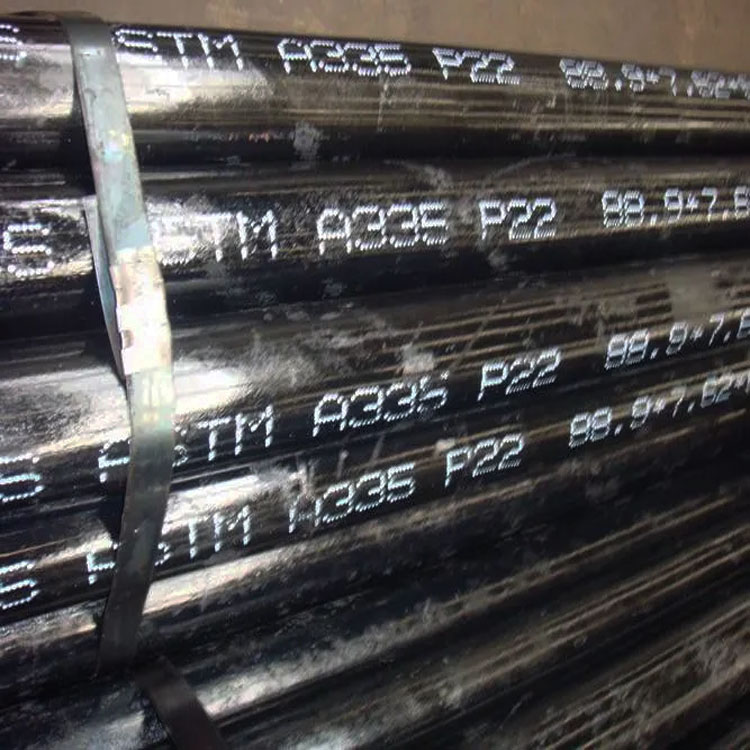
Every joint supplied against this description is new, unrun pipe: it has not been downhole, the ends have not been re-cut and the stencil has not been re-applied, and each heat is traced to its mill test certificate. On arrival, match the stencil and heat number to the certificate before the joints are racked.
An inquiry that names the following items comes back as an offer that can be read line by line. Leave any one open and two suppliers will fill it in differently, producing two prices that look comparable but are not.
| Field | Example entry |
|---|---|
| Size and weight together | 8-5/8 in. x 32.00 lb/ft |
| Grade and type | J55, K55, N80-1, N80Q or L80-1, named rather than “API 5CT” |
| Connection | STC, LTC or BTC, with the drift requirement stated |
| Length range | R1, R2 or R3 and the acceptable spread inside it |
| Certificate basis | EN 10204 3.1 or 3.2, API monogram if required, heat-number traceability |
| Quantity | Joints or meters, with tonnage basis – plain end or threaded and coupled |
Casing is the steel string run into a drilled wellbore and cemented in place. It keeps the hole open, separates formations and their pressures, protects shallow water zones and carries the wellhead. The 8-5/8 in. size is a common intermediate and production string: it is not tubing, not line pipe and is not pulled for routine workovers.
The inside diameter depends on the weight, because every step in weight adds wall. At 8-5/8 in. it runs from 205.66 mm at 24.00 lb/ft down to 190.78 mm at 49.00 lb/ft; the API drift mandrel clearance is a further 3.18 mm below each of those figures. Quote the weight with the size or the bore cannot be answered.
The published weight is a nominal threaded-and-coupled designation: 24.00, 28.00, 32.00, 36.00, 40.00, 44.00 or 49.00 lb/ft. It is not the plain-end tube mass. The plain end is lower – 35.14 kg/m against a 35.72 kg/m designation at the lightest weight, for example – and the difference is the thread and coupling allowance.
They are different OCTG products. Casing is run and cemented to line the well for its life; drill pipe is the rotating string used to drill the hole and is tripped in and out. 8-5/8 in. is a casing size. This page describes that casing only, not drill pipe or its tool joints.
No. Line pipe is a pipeline product covered by API 5L; 8-5/8 in. casing is a well string covered by API 5CT / ISO 11960. The two have different dimensional tables, end finishes and test requirements even where a nominal diameter is similar. Name the specification as well as the diameter on an inquiry.
It is the nominal outside diameter of the pipe body: 8.625 in., or 219.08 mm. It is not a bore and not a thread size. The weight designation that follows it fixes the wall, bore and drift, so an 8-5/8 joint at 24.00 lb/ft and one at 49.00 lb/ft share an outside diameter but differ by 14.88 mm of inside diameter.